
Experimental large-scale Tidal Model of The Wash
Page good for smart-phones. On PCs/Laptops it may look too large. To reduce press "Ctrl" & "minus" or click "View" then "Zoom out"
Created Mar 2013, last edited: 14/03/26, 12:03
Created Mar 2013, last edited: 14/03/26, 12:03

Introduction
The Great Ouse Catchment Board came into being in 1930 and one of it its earliest acts was the study of the river's estuary into The Wash.
Siltation there had always been a problem and in the middle of the 19th century "training walls" had been built (by the Norfolk Estuary Company) which had improved matters. Various enquiries and proposals had been put forward in the early part of the 20th century and the training walls lengthened. The new board put into effect some of the propsals but thought more scientific study was necessary to see what further improvements were possible to alleviate flooding upstream.
It was therefore decided that a scale model of the river mouth area should be built to observe the outflow of the river through the channels in the sandbanks in The Wash and changes by tidal movement.
History
Mr Oscar Borer, the Board's Chief Engineer, writing in 1938 (The Cambridge Region, chapter 14) , said the model was constructed in 1932.
Prof Darby says it was 1935, and housed in the Great Ouse Catchment Board's research laboratory in Coldhams Road, Cambridge in a "building 75 feet long by 55 feet wide. (The changing Fenland 1983 p 208 from an article by DB O'Shea Tidal model of the River Great Ouse and the Wash in Journal Inst Municipal & County Engineers 1936).
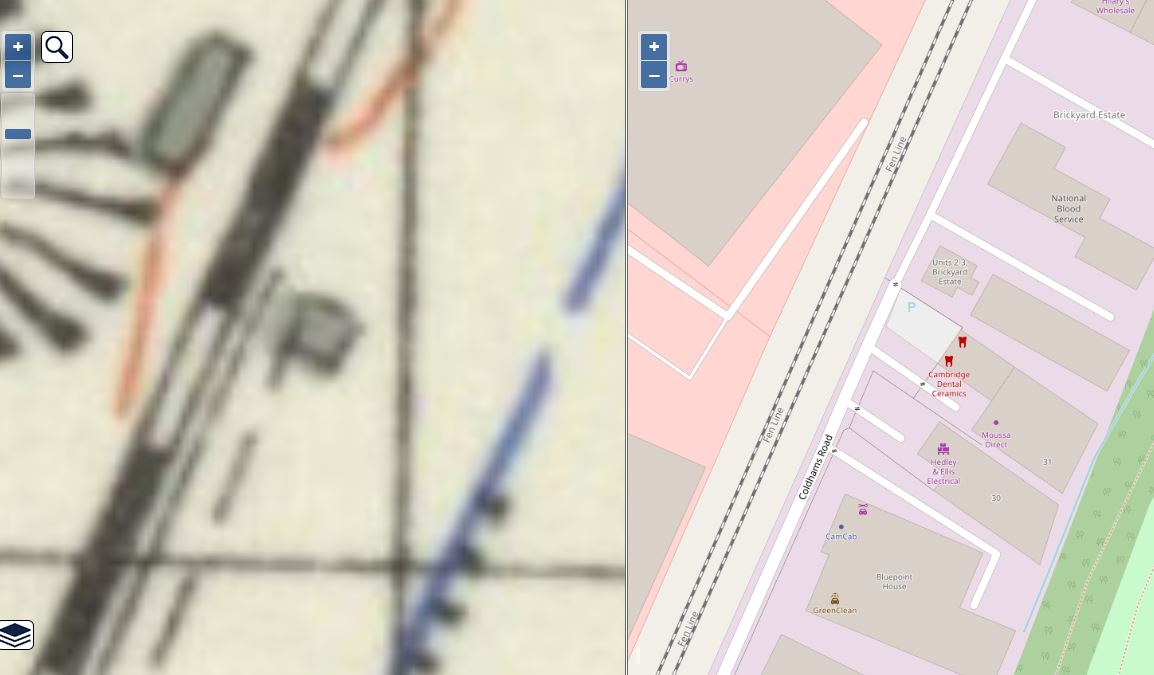 National Library of Scotland side by side maps
I've not found details of the Laboratory's location but am fairly certain it was where circled. On the left, the 1930s-60s map shows an isolated building at what was then the end of Coldham's Road. The road has been lengthened by the warehouse development to the north, but at a distinctly different width. The Laboratory site would have been in the current car-park. Click map for site enlargement.
The longer model referred to could have been from the building to the lake, an ideal souce of water.
Oscar Borer quoted a horizontal scale of 1: 2500 but a much exagerated vertical sale of 1:60. This appararently enabled a tidal period to be completed in 138 seconds, meaning a full year of tides could be observed in little over 1 day. The tidal action was produced by a huge plunger weighing 14 tons displacing water from a large trough. The plunger was controlled by a cam to produce a correct tidal cycle.icate The Wash out as far as a line from Hunstanton to near Skegness from data collected by the Admiralty in 1917 together with the Boards own data. Flow from the rivers discharging into the Wash was controlled by valves.
Darby says the model and its workshop facilities continued to be used for various purposes until 1967.
BoBorer said a 'secondary' model "is under construction" [1938] to include the river up to Denver. Although on a much smaller scale (1: 240) it would be 360 feet long and constructed outdoors. The plunger weighed 4½ tons.
CM White, Asst Prof at Imperial College in the late 1930s, said the model disclosed that training walls extending seawards usually cause large movements in the estuary, also the chief work has been determination of the tidal wave as it runs inland. Also a larger model is being built a quarter of a mile long.
| 1st model | note | 2nd model | note | |
| constructed | 1932 | 1 | under construction 1938 | 1 |
| location | indoors | outdoors | ||
| RGOCB Laboratory, Coldhams Rd Cambridge | 3, 5 | |||
| area covered | Wash estuary out to line between Hunstanton and Skegness | 1 | extended to include river Ouse up to Denver | 1 |
| length of model | "about 360 ft" "quarter of a mile" |
1 4 |
||
| horizontal scale | 1:2500 | 2 | 1:240 | 1 |
| Vertical scale | 1:60 | 2 | 1:100 | 1 |
| vertical exagertion | 1:41.7 | 2 | ||
| time scale | 1:324 | 2 | ||
| velocity scale | 1:7.7 | 2 | ||
| tidal period | 138 secs | 2 | ||
| one year of tides | 27.1 hrs | 2 | 31 mins | 1 |
| weight of plunger | 14 tons | 1 | 4½ tons | 1 |
| note | source |
| 1 | Oscar Borer, Chf Engr, RGOCB, chapter 14 in "The Cambridge Region" 1938 |
| 2 | from brochure of model, as quoted by Oscar Borer in note 1 |
| 3 | Prof HC Darby, |
| 4 | CM White, Asst. Prof, Imperial College |
| 5 | RGOCB = River Great Ouse Catchment Board (see details) |
Title of comment
Text or images
Contact webmaster: e-mail webmaster